Grade Level: Upper Secondary / Undergraduate
Subject: History / Civics / Political Science
Theme: Presidential Power, Crisis Governance, and the Legacy of the First 100 Days
Learning Objectives
Students will be able to:
- Compare and contrast the first 100 days of Franklin D. Roosevelt’s presidency with those of Donald Trump’s second term.
- Analyze how executive power and legislative process differ in times of national crisis.
- Evaluate the use of historical analogy—particularly FDR—as a rhetorical and political strategy.
- Assess the democratic legitimacy and long-term impact of different modes of governance.
Materials
- Primary Article: “Trump claims mantle of FDR’s first 100 days, but differences are stark” – The Washington Post, April 28, 2025
- FDR’s March 12, 1933 Fireside Chat transcript Miller center Emergency banking act 1933 FR
- Trump’s 2025 Executive Order on Federal Funding Freeze omar.house.gov
- Jan. 6 Committee Report Executive Summary CBS news
Supplementary Articles:
- Reuters: “Trump’s first 100 days: America First president is overturning world order”
- The Guardian: “Trump signs orders stepping up immigration crackdown and ‘unleashing America’s law enforcement’”
- Emergency Banking Act text vs. Trump’s immigration EOs (6 vs.3)
- DC National Guard deployment timeline infographic (510)
- CBS News: “Trump issues record 100th executive order within first 100 days of term”
- The Times: “Donald Trump’s first 100 days have forced necessary change”
- Excerpts from FDR’s 1933 inaugural address and New Deal legislative summaries. Study.com
Lesson Activities
Phase 1: Context and Claims
Starter Text (Paragraph 1):
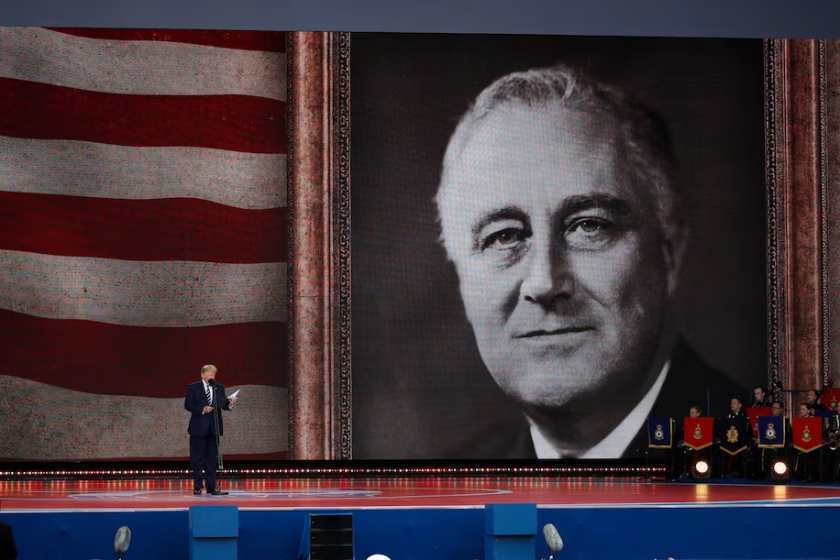
“As he nears the 100-day mark of his new term in office, Donald Trump is embracing Franklin D. Roosevelt as a model, comparing himself to the Depression-era president as he seeks to show swift action in the face of a nation in turmoil.”
Read: Paragraph 1 of the Washington Post article (“As he nears the 100-day mark…”)
Instructions:
- What historical image does Donald Trump attempt to invoke by comparing himself to FDR?
- What key conditions faced by FDR in 1933 are being mirrored or claimed by Trump in 2025?
- In your group, research and briefly describe:
- The state of the economy in 1933
- One of FDR’s first major programs (e.g., CCC, TVA, Social Security)
- How does this comparison serve Trump’s political message? Do you think it is historically accurate or strategically symbolic? Explain.
Discussion Prompt:
- How does invoking FDR change the way we might judge Trump’s early presidency?
Phase 2: Executive Action vs. Legislative Governance
Starter Text (Paragraph 4):
“In his first 100 days, Trump has issued more executive orders than any president in history — surpassing even FDR — but he has yet to push a single major piece of legislation through Congress.”
Task:
As a class, chart FDR’s early legislation (e.g., the Emergency Banking Act, CCC, TVA) and Trump’s executive orders (immigration, federal agency restructuring). In discussion groups, assess the implications of using executive orders versus passing legislation. What are the limits and advantages of each? How do these approaches reflect differing views of democracy and governance?
Phase 3: Use of Crisis Language
Starter Text (Paragraph 8):
“Trump’s aides have encouraged comparisons with Roosevelt, suggesting that the economic dislocation, migration surges, and institutional breakdowns facing the country justify extraordinary action.”
Task:
Students do a close reading of this paragraph alongside excerpts from FDR’s first inaugural address (“the only thing we have to fear is fear itself”) and media excerpts framing Trump’s return to office. In small groups, students evaluate the framing of crises. Who defines a crisis? What kinds of emergencies justify extraordinary political power?
Phase 4: Media and Public Messaging
Starter Text (Paragraph 11):
“Trump has relied heavily on conservative media to amplify his message, touting executive actions on cable news and social media platforms, while largely bypassing traditional briefings.”
Task:
Analyze how media strategy affects public perception of presidential effectiveness. Students examine headlines and video snippets from various sources—Fox News, MSNBC, and social media. Compare how FDR used fireside chats and newspaper reporting with Trump’s digital-first approach. Students will write a short analysis of how media ecosystems influence presidential image-making.
Phase 5: Critical Evaluation and Debate
Starter Text (Paragraph 13):
“Historians caution that while FDR worked through Congress to create lasting institutions, Trump has pursued a more unilateral approach that may prove less durable.”
Task:
Host a classroom debate structured around this statement. One side argues that Trump’s method is efficient and necessary for urgent issues; the other argues that FDR’s slower, more collaborative approach yields lasting democratic institutions. Each side must cite both the Washington Post article and at least one supplementary article in their arguments.
Final Synthesis and Assessment
Essay Prompt:
“To what extent do historical comparisons enhance or obscure our understanding of presidential leadership in crisis?”
Students write a short essay drawing on Trump and FDR as case studies. They must include discussion of rhetorical framing, media strategy, governance style, and long-term impact.
Assessment Criteria
- Depth of analysis and clarity of argument in written work.
- Use of direct textual evidence from both primary and supplementary sources.
- Engagement and preparation in group discussions and debate.
- Ability to critically evaluate historical analogies and contemporary political strategy.
Extension Activities
-
Research Project: Students investigate another president’s first 100 days and present a mini case study for class comparison.
-
Creative Project: Create a mock newspaper front page for either FDR’s or Trump’s 100th day in office, capturing both policy and public perception.